Whitney Museum of American Art
“Untitled” (America)
August 20, 2026
All photographs in this diary were taken during my visit.
It’s been a while since last time I visited the Whiteney Museum of American Art, which is this beautiful monumental building at the end of the High Line near 14th Street. The Chelsea Market nearby has my favorite seafood market, where Micheal and I used to sit through a Saturday evening with a dozen oysters and smuggle the white wine to drink in the park.
That was before the museum was built, while the Meatpacking neighborhood was already going through a transformation with trendy bars and high-end hotels (e.g. the Standard). Chris Whittle had made it a location for his first for-profit private school in New York. I am reminiscent now as if I was a teenager when all this happened but in fact, I was already in my late thirties. I was hanging out with friends who were also single or ambivalent about getting into a relationship, while reading books like “Just Kids” by Patti Smith, and feeling like a kid myself.
A week ago, I just came back from an exhausting one-month trip to China for business and finally got a couple of days to myself like a real mini summer vacation. I am very happy to get into something that would help me to shake off a few annoyances coming from work nowadays. A visit to the Whitney Biennial 2026 seems to fit the bill. I am not a big fan of contemporary art, but browsing the landscape of America art is still an interesting idea. Plus, the museum card from work literally grants me access to all museums to NYC for free.
On a Thursday afternoon in August, there was literally no line at the entrance to Whitney. I had with me a leather-bound journal and a small bag of pencils (mistake!), a tiny umbrella (wisely), and one headset for just the right ear (the other one was lost). A security guard cleared my bag before I could approach the front desk to present the museum card in exchange for a ticket.
I took the large elevator straight to Floor 6, which was the top floor exhibiting the Biennial. My approach was to start from the top and work my way down. The Biennial in fact spreads to Floor -1, which I was almost certain I would not be able to finish on one visit.
It turned out I only barely finished Floor 6, where the most impressive work to me was the 3 paintings by Japan-born artist Akira Ikezoe, “Frog Stories Around Nuclear Plant”, “Robot Stories Around Solar Panels”, and “Mole Stories Around Methane Gas”, about little imaginative creatures and robots depicted as characters in a circulation of energy flow. Then I wandered out of the gallery to the balcony as it seemed so much more interesting than the artwork itself inside.
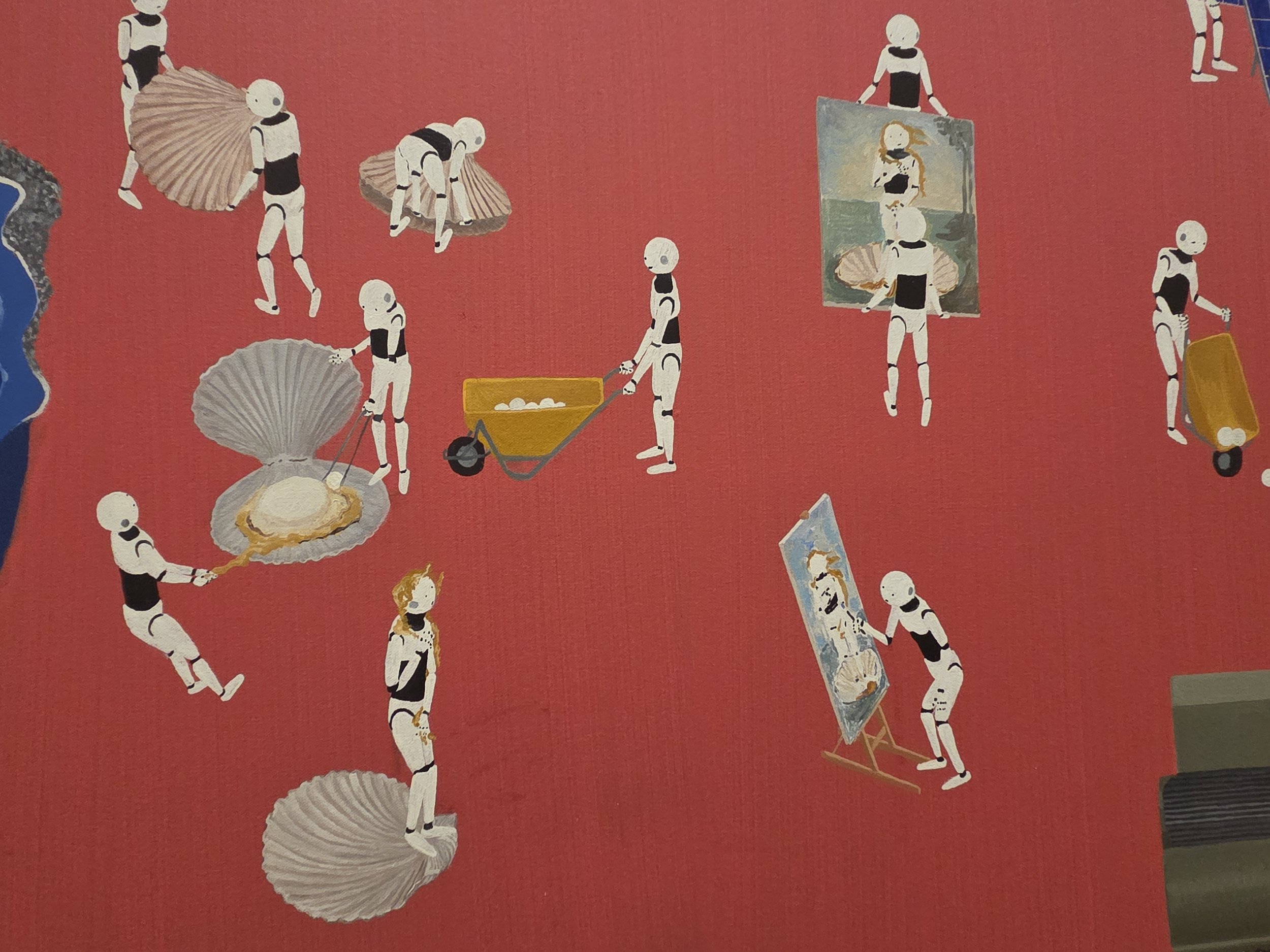
Part of “Robot Stories Around Solar Panels”, 2025 Akira Ikezoe (Oil on canvas)
I had forgotten how unique and amazing the Whitney balconies are. Obviously, the architect thought this through - the intruding plain mesh metal platforms overlooking the High Line have become the most attractive piece of art of the museum. When you stand at the edge of the balcony, you not only see the top of the standing trees, walking people, and moving cars, you feel you are on top of the art of the world, the trendy, the fashionable, and the coolest – the most valuable currency of the city of New York itself!
You could also see Little Island and Pier 57, which I planned once as a destination for a beer after sailing with Dimitri and Summer in June. And a summer storm ended that idea abruptly (Marco made linguini with clams at home instead, which was, perfecto!). Perhaps today would be a good day for a revisit.
From the balcony I went upstairs and ended up on Floor 7. The artwork on display closest to the entrance from the balcony was from Isamu Noguchi, which was particularly interesting to me as the Noguchi Museum in Astoria is just a few streets away from me. Here I am at Whitney, and he seems to be none escapable!
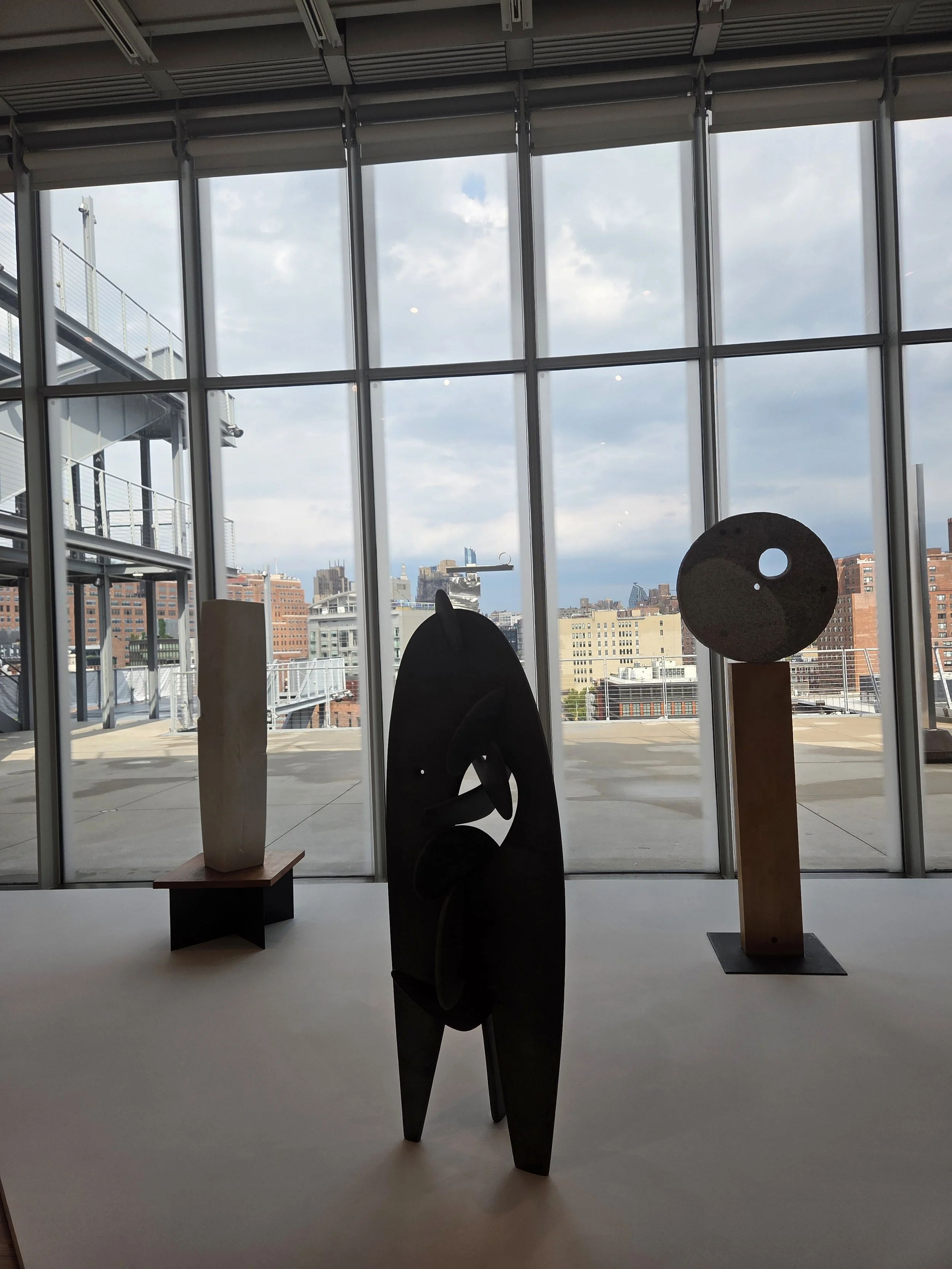
Endless Coupling (center, 1957) and Variation on a Millstone #1 (right, 1962), Isamu Noguchi
Before I got to the title wall of the gallery, I already passed a few iconic contemporary artwork that are familiar to my eyes: The White Calico Flower (1931) by Georgia O’Keeffe, Second Story Sunlight (1960) by Edward Hopper and Gertrude Vanderbilt Whitney (1916) by Robert Henri. Then I stopped in front of a large painting of a black man in an all-white long coat against a white background, with black sunglasses with a reflection of classical gothic arched windows.
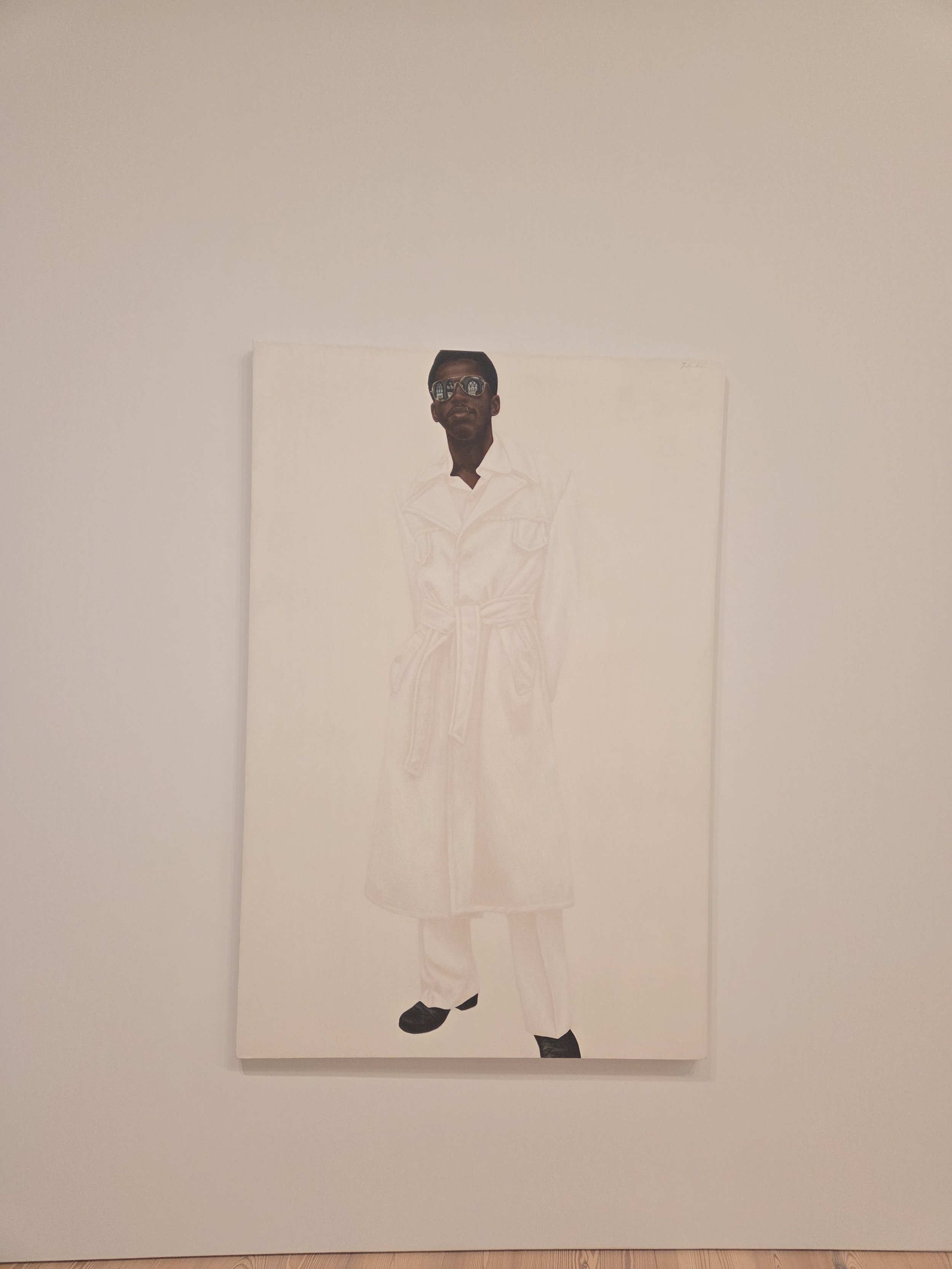
I asked ChatGPT what this artwork is, and it instantly gave me an answer which was quite thorough:
• • •
The artist: Barkley L. Hendricks
Barkley L. Hendricks (1945–2017) was an American painter and photographer best known for his striking, often life-size portraits of Black Americans. He began making these portraits in the late 1960s and 1970s, at a moment when Black figures were still conspicuously underrepresented in mainstream American portrait painting.
Rather than primarily depicting celebrities or political leaders, Hendricks was fascinated by ordinary people with extraordinary presence—people he encountered on city streets whose clothes, posture, attitude, or personal style caught his attention.
That is exactly the background of this painting. The Whitney says Hendricks encountered Steve in the city; Steve wasn't someone Hendricks knew personally. Apparently, essentially all that is known about the sitter is his first name.
Why Steve is so interesting
Look again at what you photographed. At first it almost seems as though part of the painting has disappeared.
Steve's face, sunglasses and shoes are intensely rendered, while the white trench coat and trousers almost dissolve into the white background. Hendricks uses extremely subtle whites and pale outlines to describe the clothing.
That makes Steve's dark skin visually very powerful without making the painting overtly dramatic.
And then there are those sunglasses. The lenses reflect architectural windows/the surrounding city, giving you a glimpse of a world that otherwise doesn't appear in the painting. Steve looks outward, but because of the glasses, you can't meet his eyes. He controls how much of himself you are allowed to see.
There's also something very 1970s about his attitude: the long coat, flared trousers, dark shoes, sunglasses, hands in pockets. He's fashionable, relaxed and completely self-possessed.
Why is it at the Whitney now?
This is the especially interesting part.
Steve isn't visiting the Whitney for a temporary Hendricks exhibition. It belongs to the Whitney's permanent collection, and it is currently displayed on the 7th floor in the collection exhibition “Untitled” (America), which opened July 5, 2025 and is intended to remain on continuous view.
Whitney's page for Barkley L. Hendricks's Steve
The exhibition asks a much larger question: What is American art, and whose America does it represent? It combines works from roughly 1900 through the early 1980s and looks at different versions of American identity, place, popular culture, mass media, abstraction and representation.
And the placement of Steve is quite deliberate. The Whitney has hung it in proximity to works by Edward Hopper, Kay WalkingStick, Jasper Johns, Georgia O'Keeffe and Alma Thomas.
So Hendricks's anonymous Black man in sunglasses is effectively being placed inside the canon of American art, rather than treated as belonging to a separate category of “Black art.”
That's one reason the picture has become increasingly important. It asks a deceptively simple question: Who gets to stand in a museum portrait and simply be important?
Steve isn't famous. He isn't doing anything heroic. He's just standing there—stylish, confident and monumental.
And in 1976, that itself carried considerable meaning.
One other detail you may appreciate: 1976 was the U.S. Bicentennial. So seeing Steve now inside an exhibition literally called “Untitled” (America) adds another layer to the question of who represents America. The Whitney's curatorial framing explicitly presents the exhibition as multiple artists' distinct visions of “America.”
If you're at the Whitney right now, I can also point out 5–6 other works on that floor worth stopping for and explain why, rather than trying to see everything.
• • •
My blinded self-guided tour of Whitney Floor 7 was essentially over. ChatGPT took over as a docent and the following are the artworks I stopped for and learned about, much to its credit:
Barkley L. Hendricks, Steve, 1976
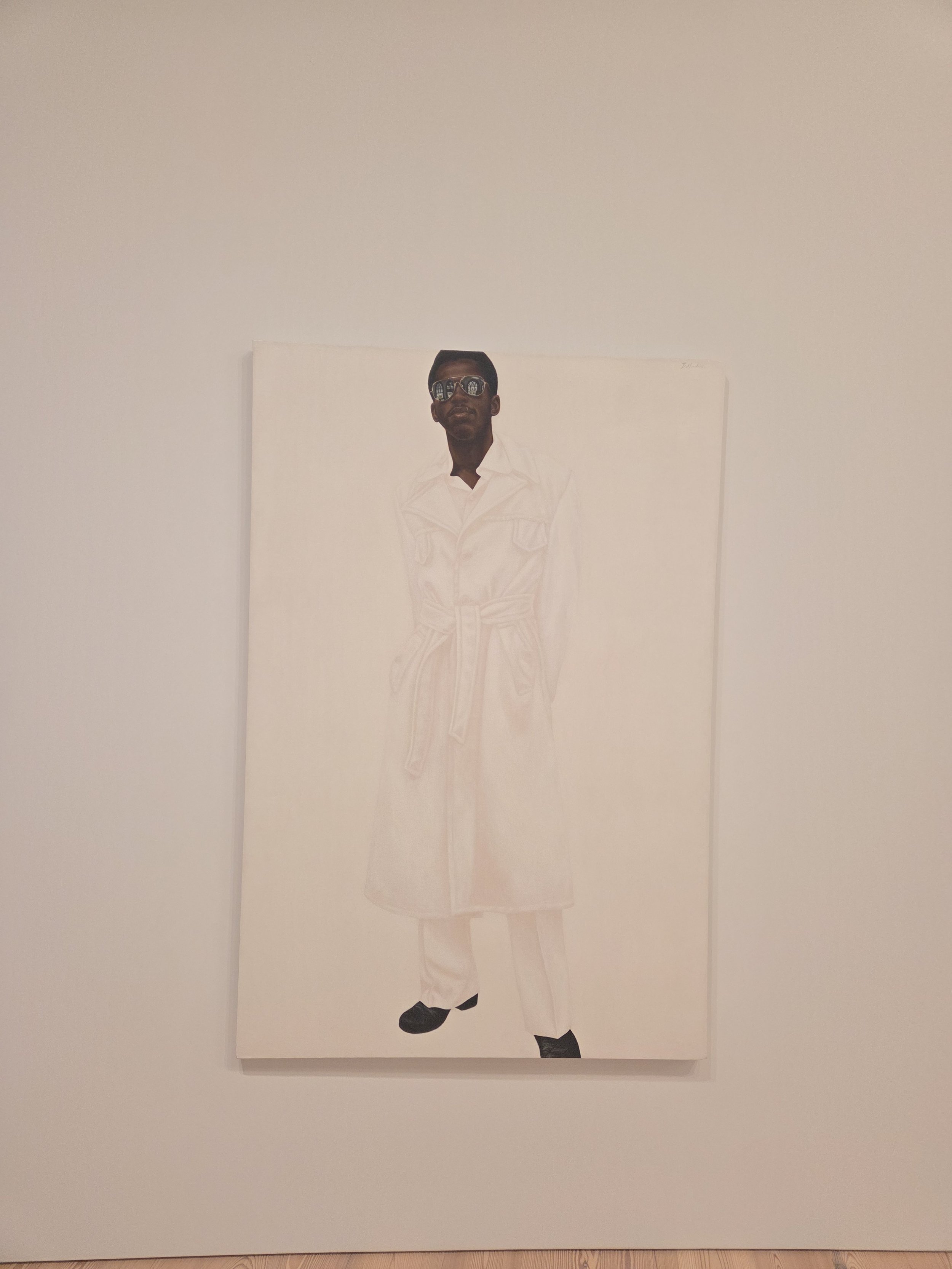
The nearly life-size portrait of a stylish Black man is dressed almost completely in white. His coat and trousers nearly disappear into the pale ground, while his face, sunglasses, and shoes remain sharply present. Hendricks gives an ordinary individual the scale and dignity traditionally associated with important portrait subjects. Created in the American Bicentennial year, the work quietly asks: who gets to stand in a museum and represent America?
Andy Warhol, Green Coca-Cola Bottles, 1962
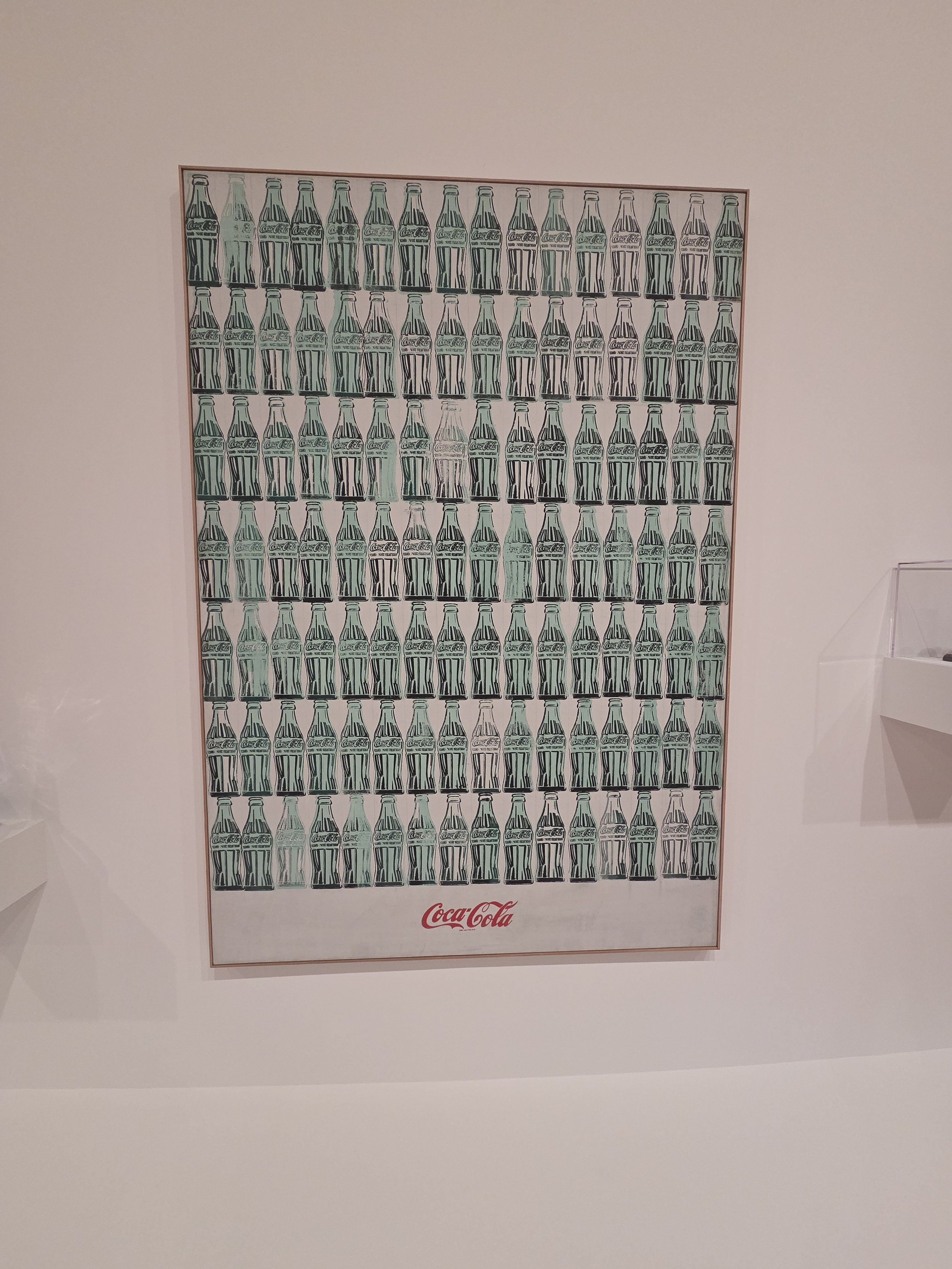
Warhol offered a different portrait of America: America as consumption. The repeated bottles initially seem identical, but closer inspection reveals variations and imperfections. The red Coca-Cola trademark at the bottom has almost the authority of an artist's signature. The painting turns an inexpensive everyday drink into an icon of postwar American consumer culture.
Jean-Michel Basquiat, Hollywood Africans, 1983
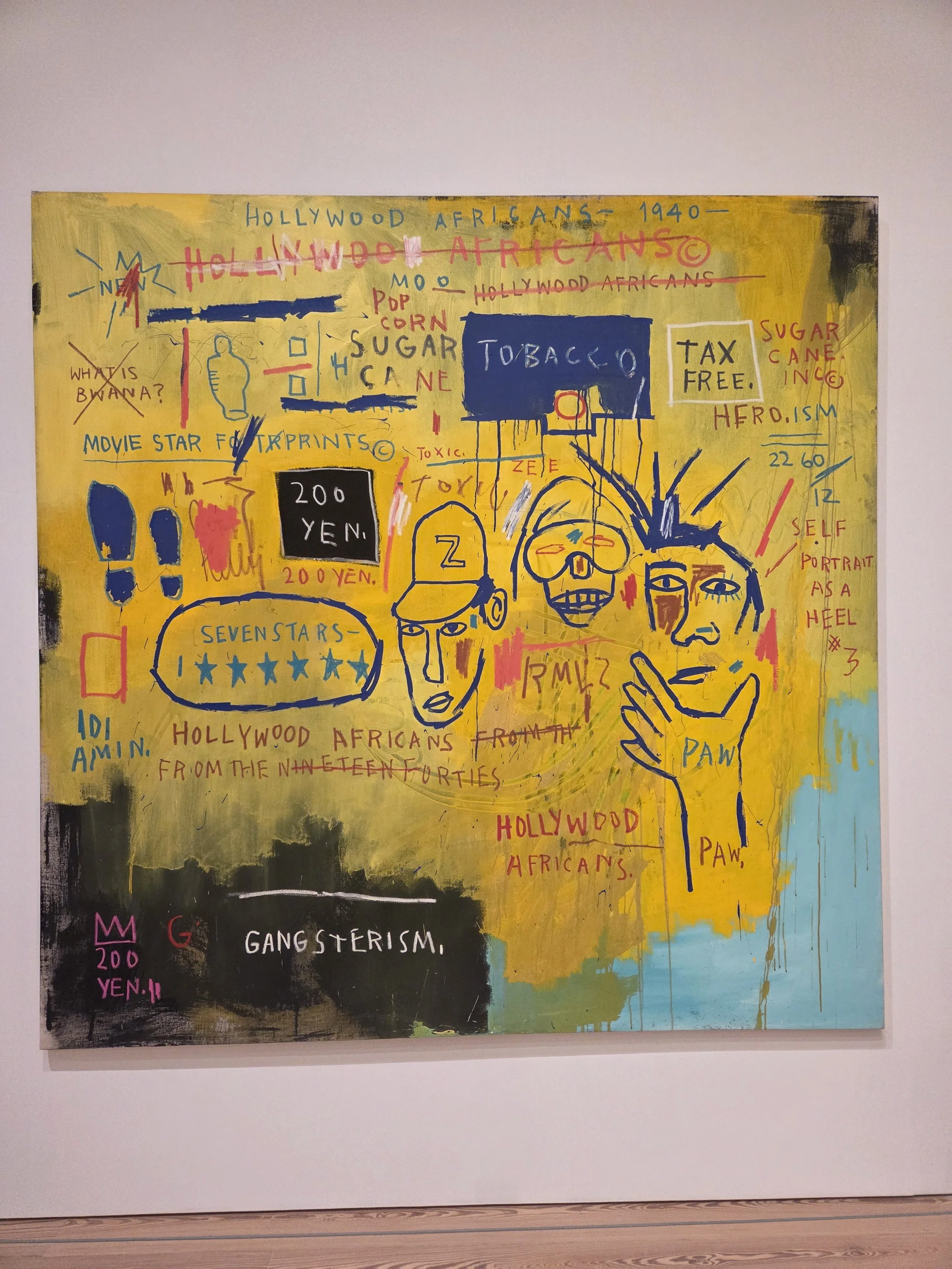
Basquiat turns toward race, Hollywood, celebrity, stereotype, and cultural power. Words such as “SUGAR CANE,” “TOBACCO,” “GANGSTERISM,” and “HOLLYWOOD AFRICANS” compete with figures, numbers, symbols, and crossings-out. Seen near Warhol, the dialogue is striking: Warhol examines how America manufactures products and images; Basquiat asks who controls those images, who profits from them, and who is reduced to one.
Nam June Paik, Magnet TV, 1965
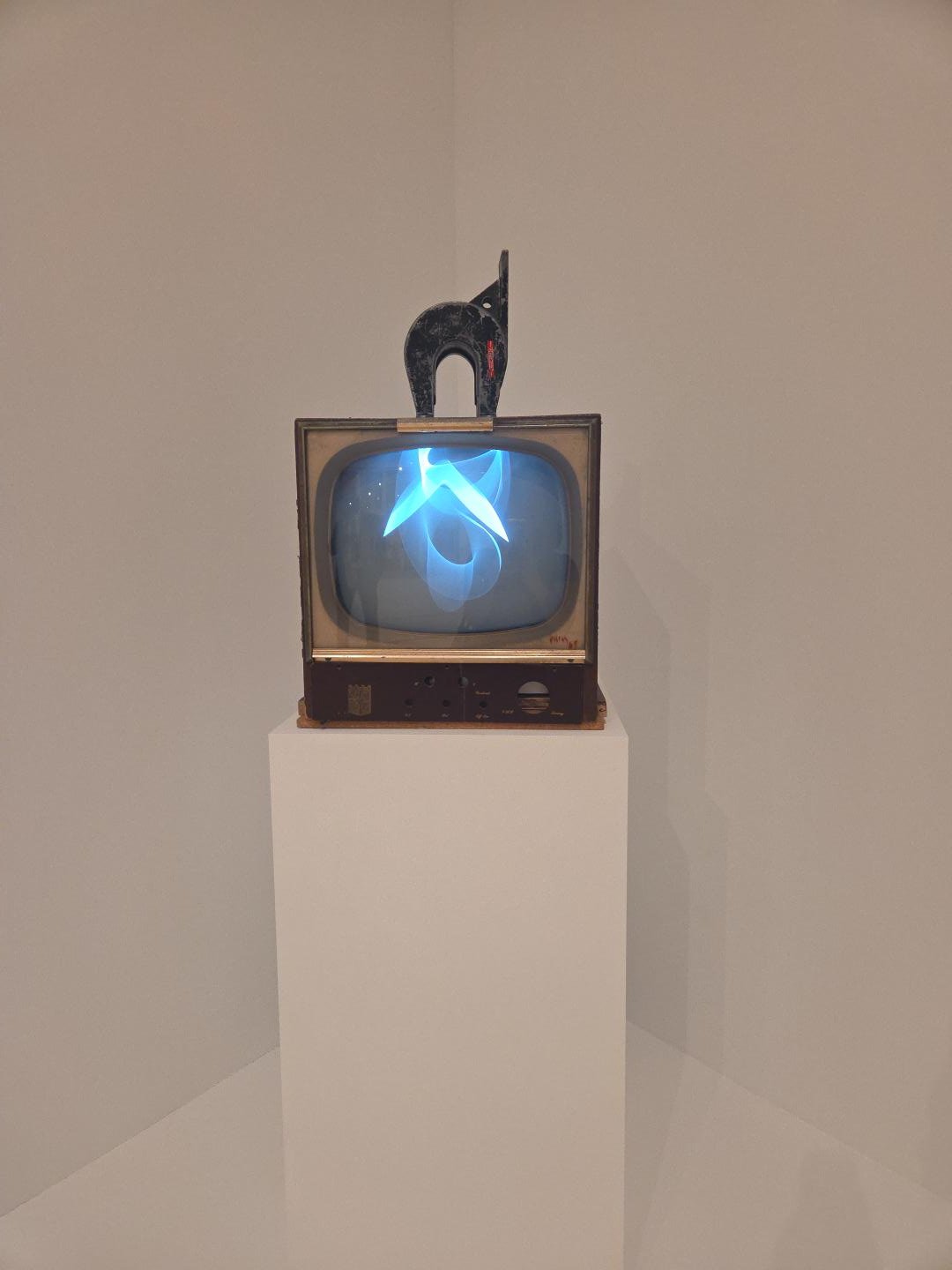
Paik transforms an ordinary television into an artwork by using a magnet to distort its electronic image. Instead of passively receiving mass media, the viewer encounters television as material that can be disrupted and reshaped. Born in Korea and later based in New York, Paik adds a distinctly transnational Asian American dimension to the exhibition and helped establish video as a new artistic language.
Barnett Newman, The Promise, 1949
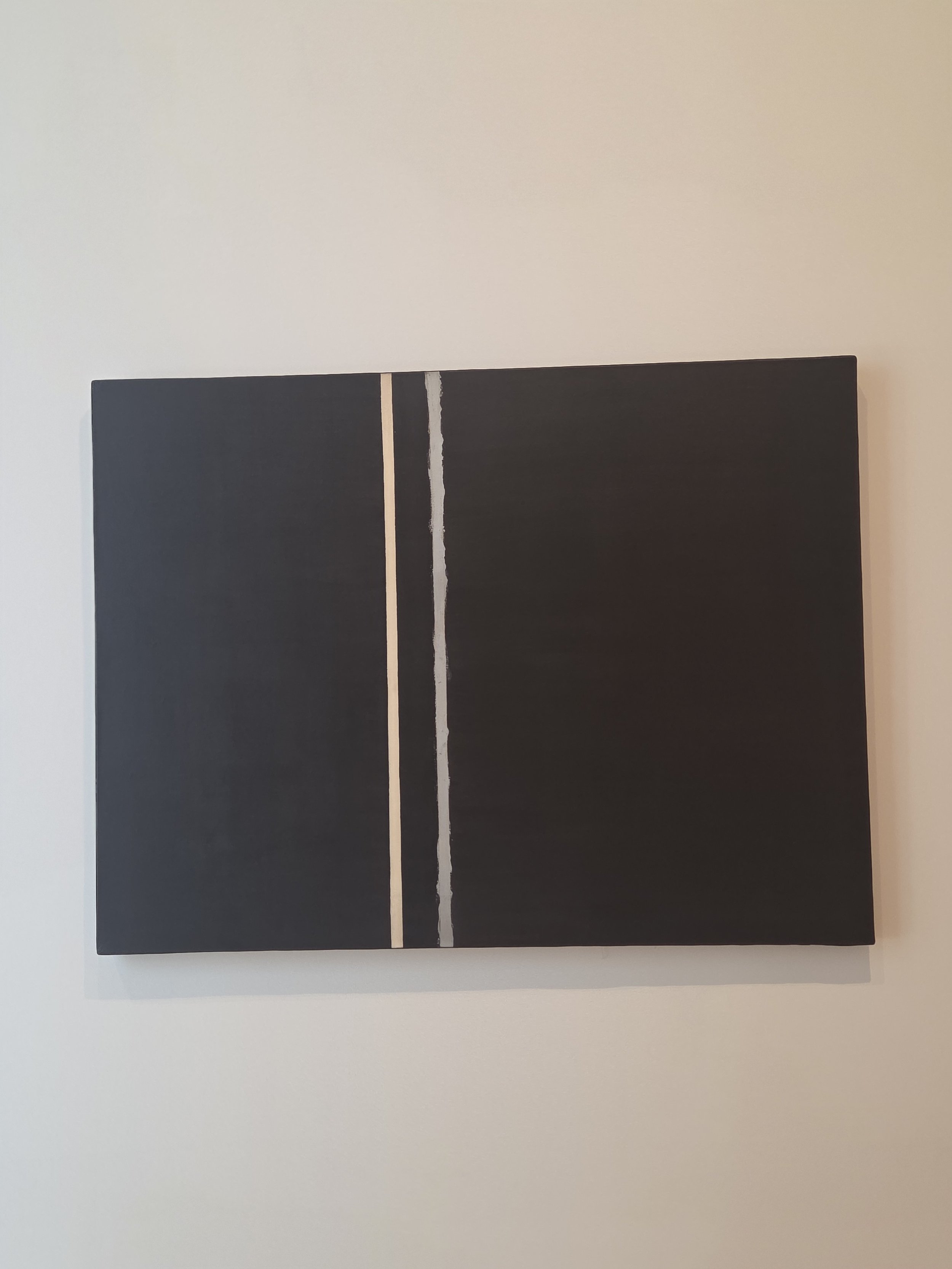
After Basquiat's visual intensity, Newman felt almost shockingly quiet. A black field is interrupted by two narrow vertical “zips,” one precise and one irregular. The painting shows how minimal visual intervention can transform an entire space. Rather than representing a recognizable subject, Newman asks us to experience scale, darkness, division, balance, and presence.
Zilia Sánchez, Eros, 1976/1998
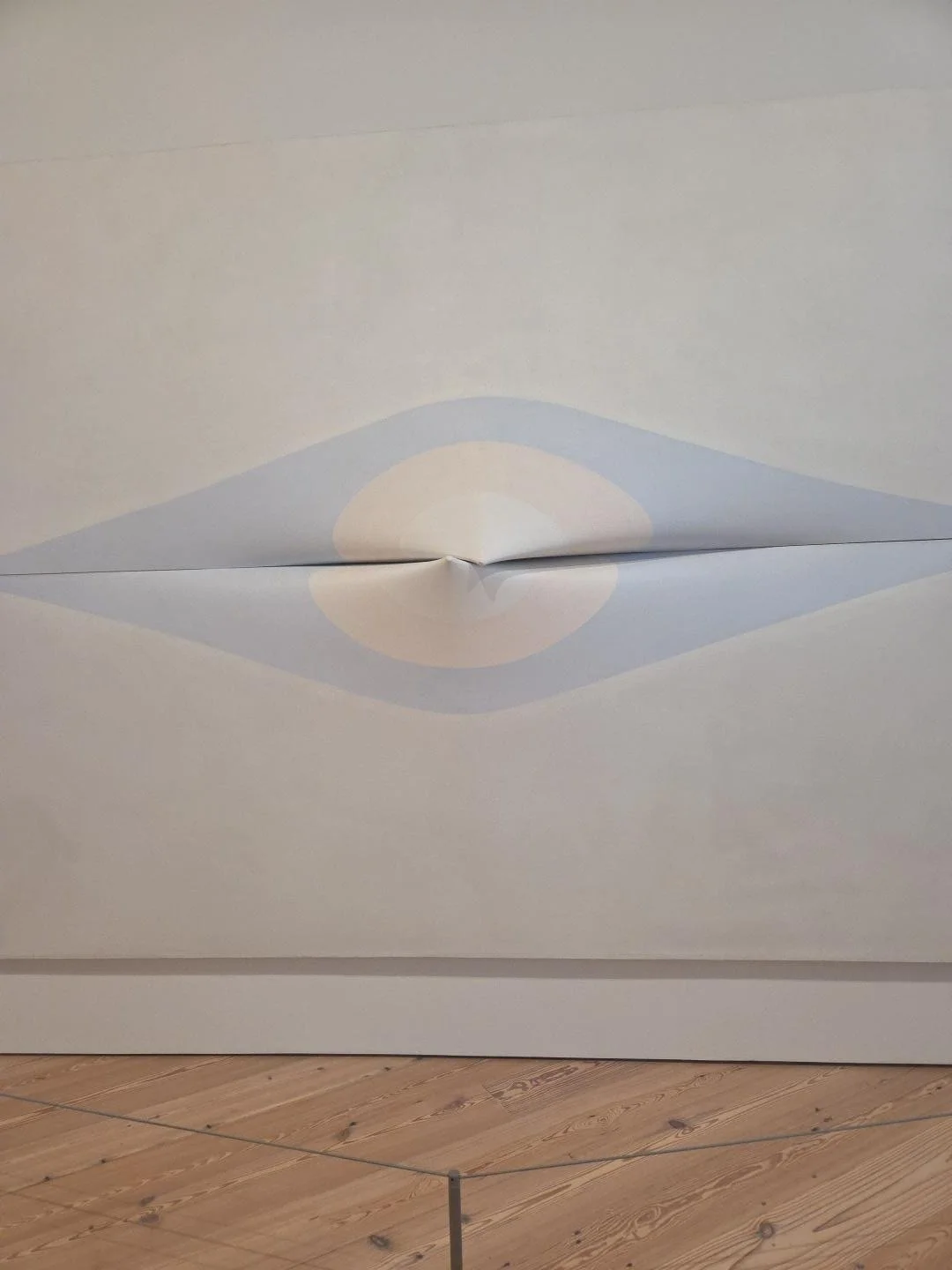
With Sánchez, painting develops a body. The shaped canvas projects from the wall, and its pale forms can suggest an eye, lips, landscape, sexual anatomy, or bodies touching without settling into a single interpretation. Abstraction becomes intimate and sensual. Walking past the work is essential: from an angle, the “painting” becomes sculpture.
Jay DeFeo, The Rose, 1958-1966
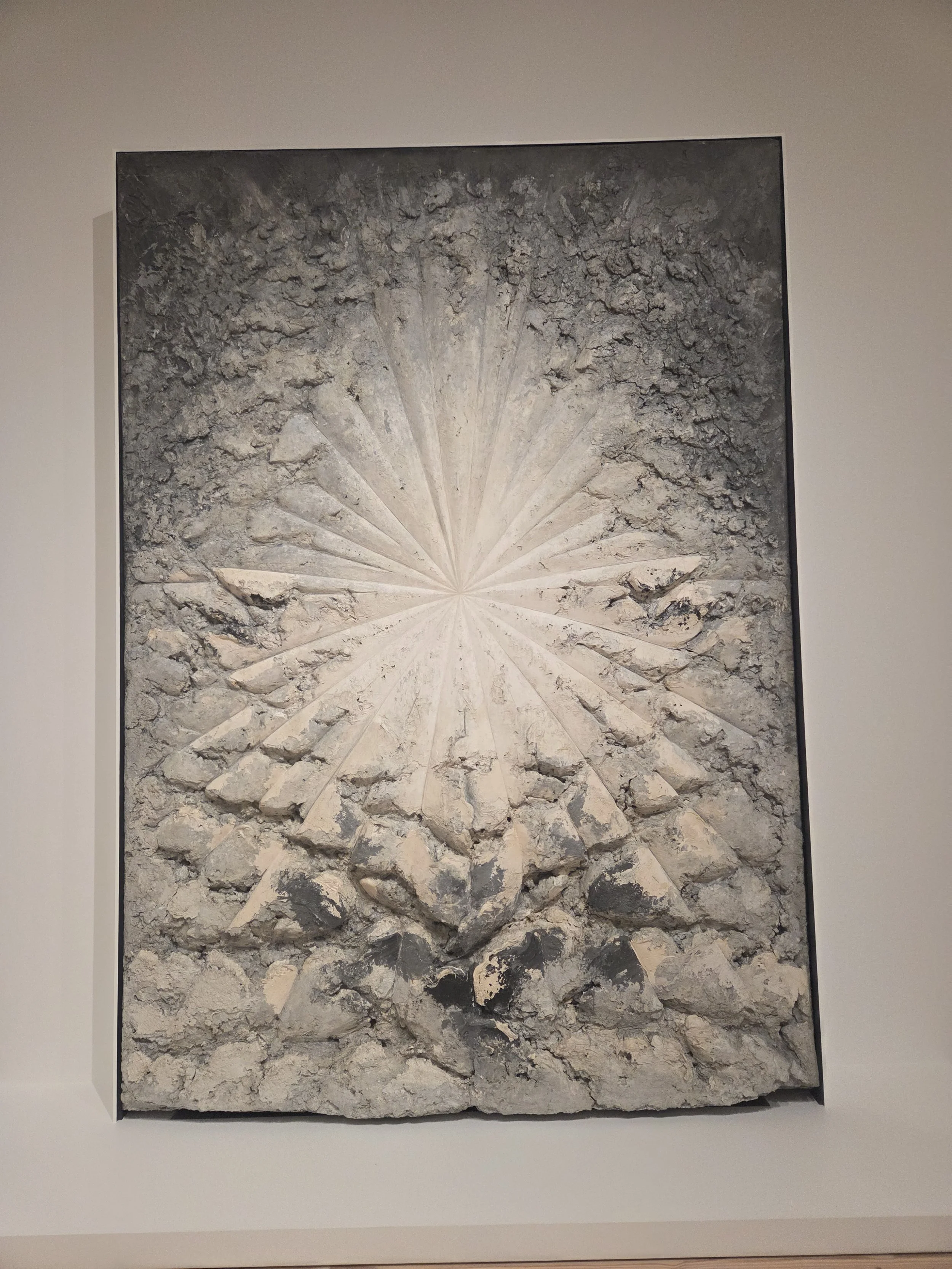
Perhaps the most physically astonishing work of the visit, The Rose was built, carved, removed, and rebuilt over nearly eight years. From a distance its radiating center suggests a flower, sunburst, explosion, or apparition. Up close, the surface reveals cracks, gouges, accumulated matter, and immense labor. From afar: order and transcendence. Up close: struggle, destruction, and reconstruction.
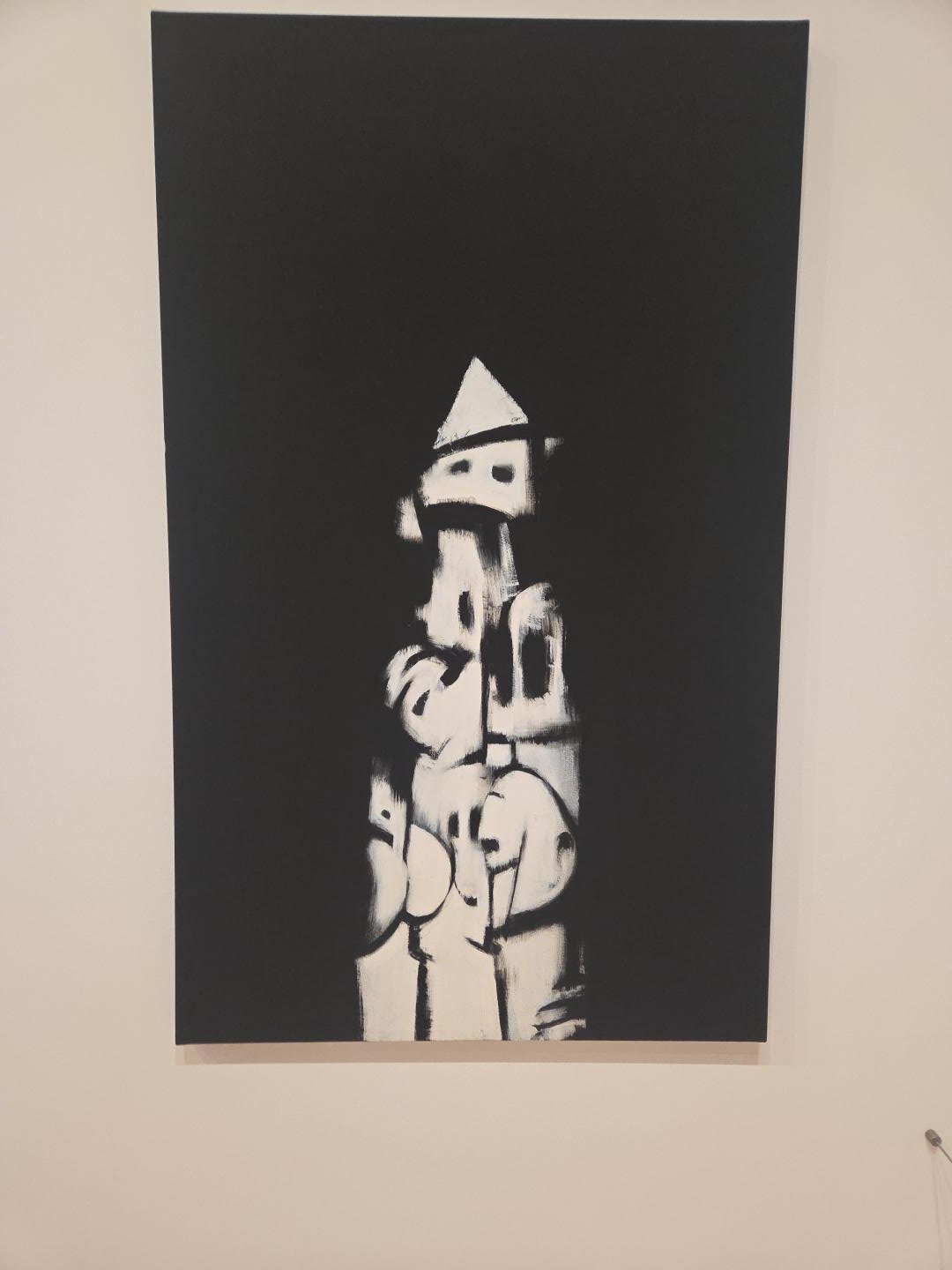
Norman Lewis, American Totem, 1960
At first this appears almost completely abstract: a small white apparition emerging from a vast black field. Then the triangular form at the top begins to evoke a Ku Klux Klan hood, changing the emotional register of the entire painting. Lewis allows racial history to emerge quietly from abstraction. Where Basquiat speaks loudly through language and symbols, Lewis whispers.
Isamu Noguchi - sculpture installation
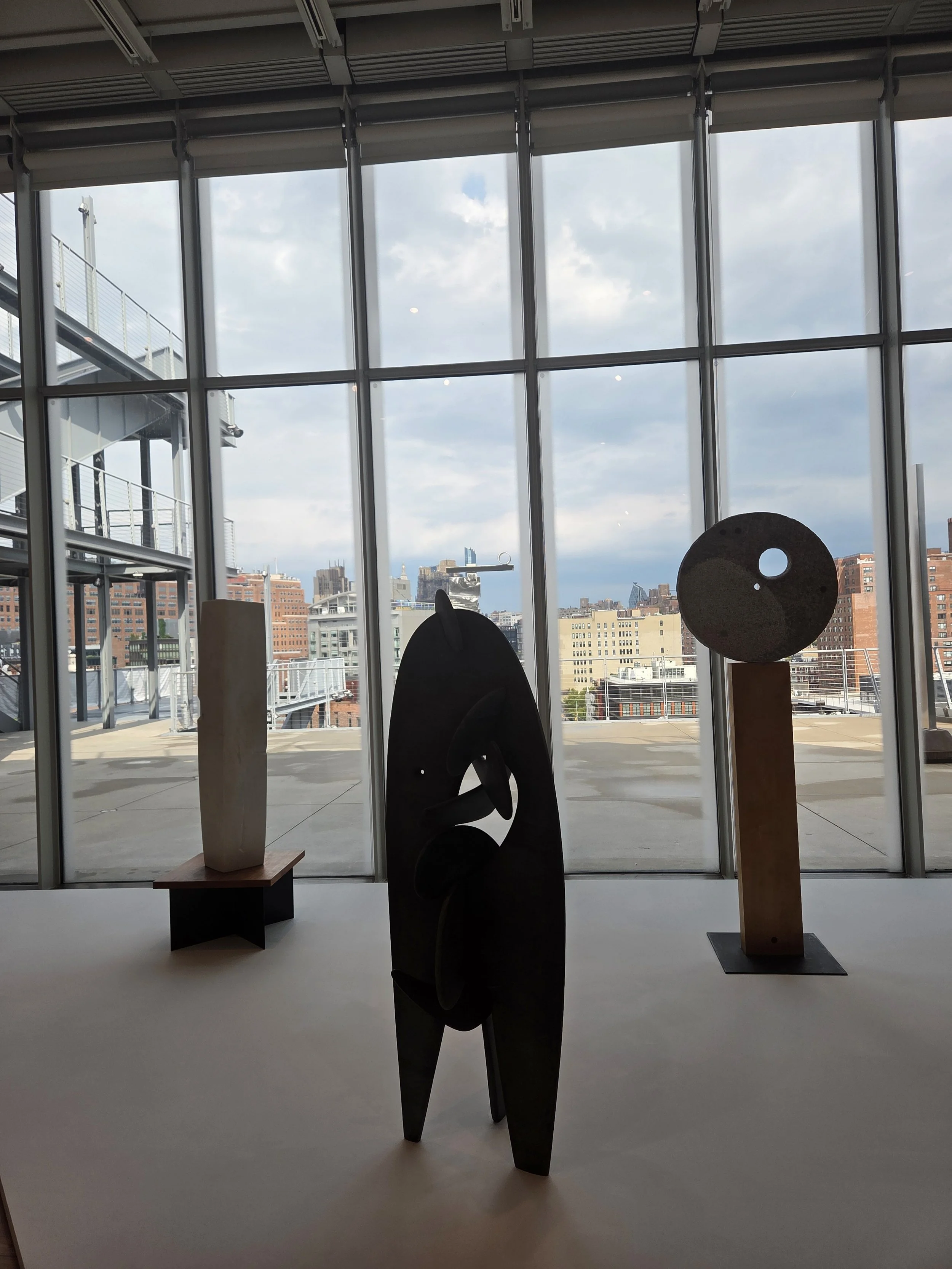
I specifically looked for Asian American representation and went back for Noguchi's powerful sculptures. Born in Los Angeles to a Japanese father and American mother and raised partly in Japan, Noguchi spent his life moving between cultural traditions. In this installation, stone, wood, openings, circles, and organic forms meet the New York skyline through the Whitney's windows. America appears here as migration, hybridity, and belonging to more than one tradition at once.
Ultimately the exhibition titled “Untitled” (America) on Floor 7 turned out to be much more interesting to me than the biennial. In the end, Marco joined me at the museum shop in the lobby, just before a storm came. We didn’t get to Pier 57 this time either but had clam linguini again!
The Coffee Lab, Astoria, New York,
August 20, 2026